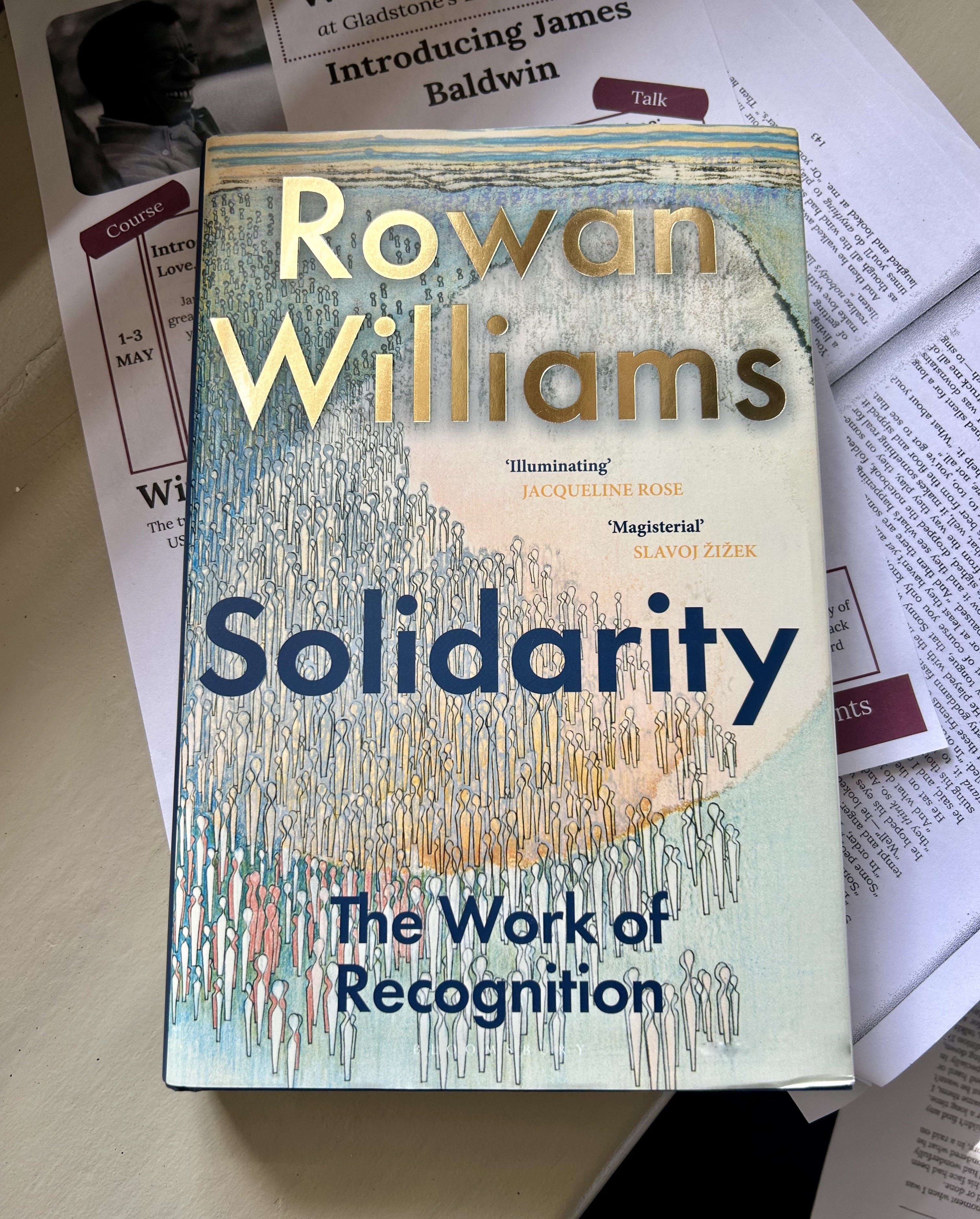
I’ve been anxiously awaiting former Archbishop of Canterbury Rowan Williams’ new book Solidarity: The Work of Recognition. He and I have talked about the topic privately and publicly as a place where our passions and discourse intersect, and although I’ve not finished reading, already I can tell two things.
First, in his customary way, Rowan is constructing complex arguments that feel far truer and more complicated than the simple binary discourse to which we are accustomed.
And second, the actual work of solidarity requires constant attention, adjustment, and the awareness that we are not seeking for others to be just like us, but are seeking to accept their individual humanities, to accept that they are just like them.
In his prefatory remarks, Rowan writes of the challenge
An understanding of solidarity that involves the continuing work of recognition and self-questioning, the continuing labour of identifying possible shared discourses of value and hope, a continuing seriousness about difference and difficulty, and a persistent sense of the inexhaustibility of human worth seems at the moment a spectacularly counter-cultural position. (6-7)
This Substack is reader-supported. To receive new posts and support my work, consider becoming a free or paid subscriber.
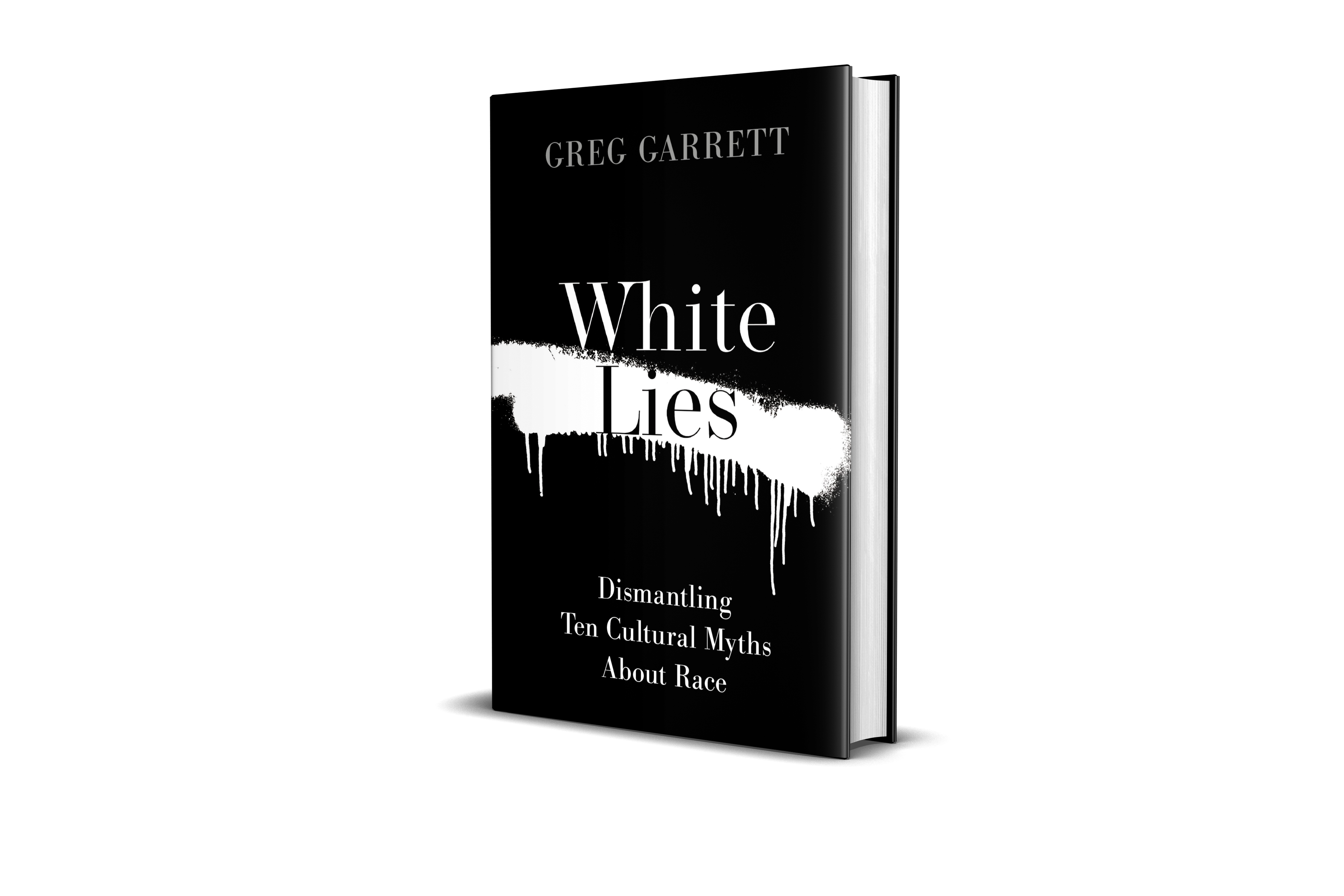
Counter-cultural, perhaps, but essential if American democracy—any democracy—is to survive this horrifying moment. The loudest and most hateful voices in our cultures insist that there can be no connection, no solidarity, with people who are not “just like us.” A while back, Robert P. Jones and I were doing an event in Paris. I was telling him about the Far Right election posters I’d seen on a wall while walking to the Galeries Lafayette to do some Christmas shopping for my girls. In this excerpt from my forthcoming White Lies:Dismantling Ten Cultural Myths About Race (edited a bit here for context and brevity), I talk about his response and my conclusions. The stats may have shifted a bit since I turned in the manuscript, and I hope would reflect growing discontent with the Trump administration, but the voices remain too loud and hateful. I can hear them now. From White Lies:
In a square a few blocks from the store, I discovered a wall covered with posters for the upcoming European Union election featuring Marion Maréchal (cousin of Marine Le Pen) and Éric Zemmour, two hard right French politicians running under the slogan “Défendre notre civilisation.”
Defend our civilization.
In our Sunday morning program together at the American Cathedral, I told Dr. Jones about the poster and asked him what he could tell us about these French election slogans. What he said stuck in my mind and in my heart.
“Whenever anyone says ‘our culture,’” he said, “‘our nation,’ or ‘our civilization,’ it is always a white supremacist tell.”
Almost daily I hear media figures and American politicians talking about “our culture” and “our country,” and it is the not-even-disguised version of another hateful racist myth. We could call it “America for Americans,” or “white Christian nationalism,” or use the wondrous repeated line from Spike Lee’s BlackKklansman, “God Bless White America.” But in any case, it evokes a myth that America was created by straight white Christian Protestant males for straight white Christian Protestant males, and that America must be defended against people of color, immigrants, LGTBQ people, feminists, or anyone who doesn’t share the tenets of a conservative Christian faith.
What we are seeing in America is the culmination of decades of evangelical Christians seeking a theocracy—rule by religious principles—because, they say, America is a Christian nation, and “our nation,” “our culture,” and “our faith” must be defended against replacement. As Robby Jones’ Public Religion Research Institute (PRRI) finds in recent polling, the highest proportion of Americans believing violence may be necessary to “save our country” may be found in the ranks of white evangelical Protestants (31%). [i] When I join a flood of commentators in suggesting that white Christian nationalism represents an existential threat to American democracy, I’m simply looking at the stats and at the stories. [ii]
White Christian nationalism is in the news daily saying the quiet parts out loud. Where once it employed dog whistles like the “our culture” construction to spread its message, now it spews hatred and threatens violence. White Christian nationalists stormed the Capitol on January 6 waving American flags, Christian flags, and Confederate flags, wearing battle armor, Trump hats, and Christian-branded clothing. White Christian nationalists have marched in Southern cities just as the Ku Klux Klan used to publicly parade. If you’re active on social media—and I am—then you can see this contest play out every day on X (formerly Twitter) as nationalists attack other Christians, Democrats, or election denial deniers as weak and woke. Many white conservative Christians self-identify on social media as “Christian nationalists.” They claim that identity and advance that myth in their posts and even include it in their bios.
A number of American political figures have also proudly identified themselves as white Christian nationalists. NPR reported that in 2023, Rep. Marjorie Taylor Greene, R-Ga., said that Republican party leaders need to pay more attention to the core beliefs of the party’s base, which she said is composed of Christian nationalists: “‘We need to be the party of nationalism,” she said. “I am a Christian and I say it proudly, we should be Christian nationalists.” [iii] GOP Speaker of the House Mike Johnson espouses white Christian nationalist views and is widely identified as a Christian nationalist who has spent his career fighting the so-called “culture wars” to save a version of America. [iv] And PRRI reported in 2024 that a majority of Trump supporters, white evangelical Christians, and people in red states have positive views of white Christian nationalism, even though that adherence may require them to take up arms to protect “their” America. [v]
White Christian nationalism may be a minority grouping in contemporary America, but it takes up a whole lot of air in the room because these are loud, hateful, and dangerous voices, and because they bubble up out of a long history of exclusion and violence directed against those who are not white, not a certain type of Christian, not on a certain side of cultural issues. When former President Trump utters hateful and divisive rhetoric at rallies, when it’s spread on national media outlets, when it’s preached from some of the most powerful pulpits in America, it takes up a terrifying amount of space in the public square, and these hate-filled myths often lead to physical violence. James Baldwin, speaking of the hateful racist rhetoric uttered by Southern politicians in the 1960s, noted that their rhetoric had killed and maimed people, and that it was intended to. So too do we see violence growing out of public figures who spread the myth that America is meant to be ruled by white Christian men, and anything that stands in opposition to that myth may require Christian patriots to take up arms to preserve the status quo. [vi] Dylann Roof did so when he murdered nine Black worshipers in Charleston’s Mother Emanuel Church in 2015, and so have others who have directed deadly violence against people who stand in the way somehow of “our America.”
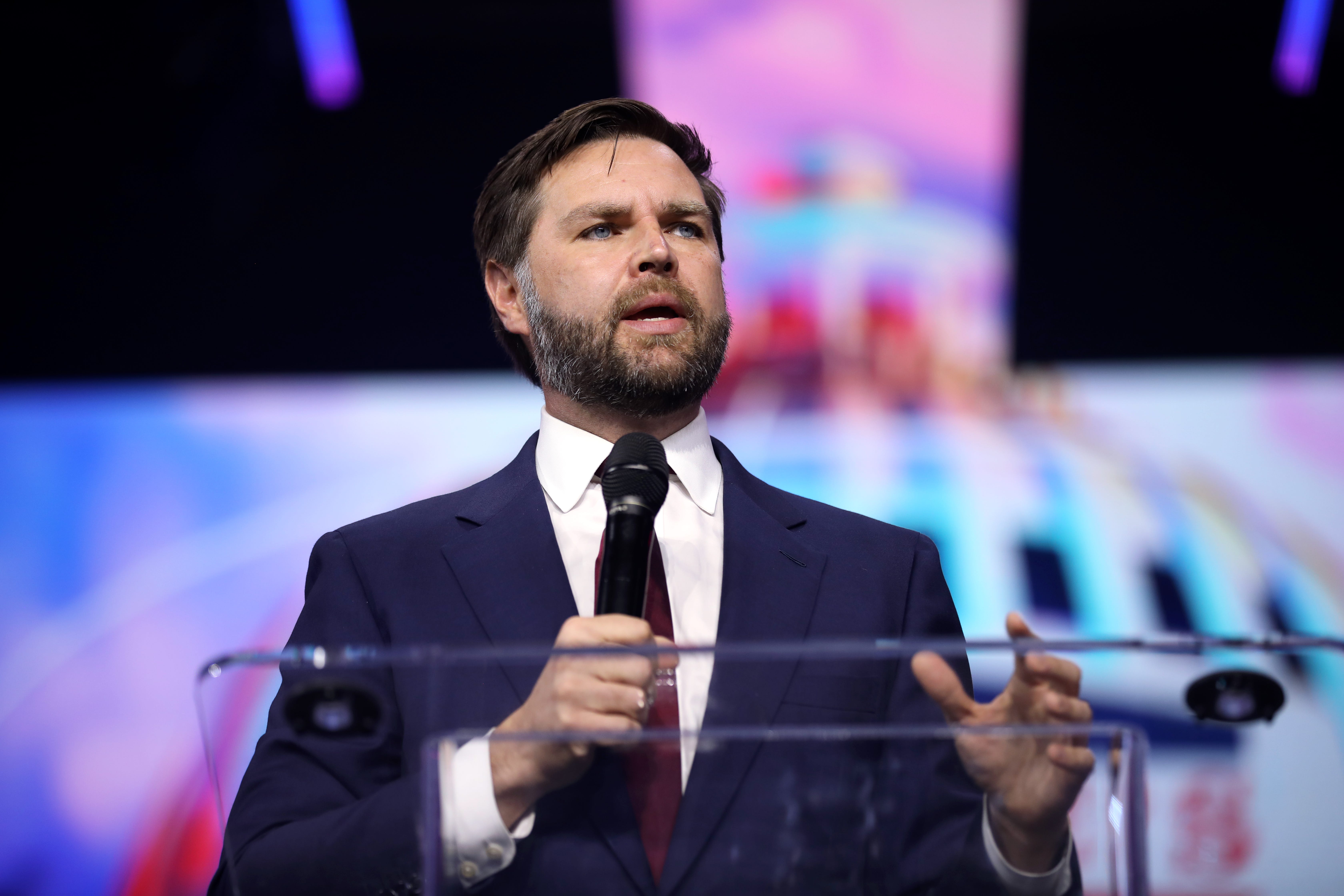
Vice President J. D. Vance has lately been one of the voices arguing that America is not a nation founded on shared ideals like freedom and democracy, but on ancestry, tenure, and race. Instead of being a nation founded on ideas, he asserts, America is a nation based on blood and soil. (It sounds better in the original German, “Blut und Boden”). All these people who don’t share our blood (I can hear Donald Trump whingeing on about how immigrants poison “our” blood) and don’t already occupy the land can never become real Americans.
Moreover, they shouldn’t even be in “our” America.
People don’t fight for ideas, is Vance’s argument. They fight for blood and soil.
Setting aside that he is himself fighting for an idea, the danger in Vance’s idea is apparent. The white descendants of Confederates who committed treason and took up arms against the American idea, the white January 6ers who sought to overthrow American democracy, have, in this argument, more claim to be Americans than former slaves, immigrants, refugees who have done the hard work of trying to love America, are doing the hard work of trying to make the idea of America work.
“America for Americans” is a repudiation of 250 years of immigration and diversity, of American greatness, and it will be the end of the American experiment should it succeed.
I’ll speak more about the dangers of an American theocracy, this warped and hateful pseudo-Christianity based on hate instead of love, exclusion instead of compassion, but “blood and soil” is plenty to digest for the moment.
J. D. Vance and white Christian nationalists call for a worldview that does not and cannot see the humanity of all God’s children. Rowan Williams’ Solidarity calls us to the hard and ongoing challenge of doing exactly that.
And I choose Rowan Williams over J. D. Vance every day of the week.
My faith in God and in democracy—in that order—tells me that I’m called to love, serve, and see all my neighbors, and I hope you will join me.
[i] “Threats to American Democracy Ahead of an Unprecedented Presidential Election,” PRRI October 25, 2023. Accessed at: https://www.prri.org/research/threats-to-american-democracy-ahead-of-an-unprecedented-presidential-election/
[ii] Greg Garrett, “‘What the hell is wrong with these people?’: An Advent message on Christian white nationalism and the end of America,” Baptist News Global December 20, 2023. Accessed at: https://baptistnews.com/article/what-the-hell-is-wrong-with-these-people-an-advent-message-on-christian-white-nationalism-and-the-end-of-america/
[iii] Ashley Lopez, “More than half of Republicans support Christian nationalism, according to a new survey,” National Public Radio February 14, 2023. Accessed at: https://www.npr.org/2023/02/14/1156642544/more-than-half-of-republicans-support-christian-nationalism-according-to-a-new-s
[iv] Melissa Gira Grant, “Mike Johnson Is the Christian Nationalist We Should Have Seen Coming,” The New Republic December 20, 2023. Accessed at: https://newrepublic.com/article/177474/mike-johnson-christian-nationalist-seen-coming
[v] PRRI Staff, “Support for Christian Nationalism in All 50 States: Findings from PRRI’s 2023 American Values Atlas,” PRRI February 28, 2024. Accessed at: https://www.prri.org/research/support-for-christian-nationalism-in-all-50-states/
[vi] James Baldwin, No Name in the Street, 1972 (New York: Vintage, 2000), 131.